Wabisabi Antiques
Antique Japanese furniture Byobu wind screen of hand painting Tale of Genji 1700s Real Gold Clouds Sea W111in/W282cm
Antique Japanese furniture Byobu wind screen of hand painting Tale of Genji 1700s Real Gold Clouds Sea W111in/W282cm
Couldn't load pickup availability
Size: H 26.4in × W 80.3in × D 0.6in (about H67cm×W204cm×D1.5cm )
Weight: 16lbs (7.3kg)
Material: wood, paper, Gold leaf, silk, metal,
This painting depicts Genji from The Tale of Genji. While most of the composition is rendered in gold-leaf clouds and blue sea, a closer look reveals an aged man gazing wistfully into the distance.
This man is none other than Hikaru Genji. The Tale of Genji, written by Murasaki Shikibu, is one of the world's oldest long novels. It deeply explores the protagonist Hikaru Genji's turbulent love affairs, the splendid life of the aristocratic society of the time, and human psychology. It is highly praised for vividly depicting the protagonist's rise and fall.
This scene depicts the adult Genji reminiscing about when he was young and danced the Aogashira dance with the Emperor Suzaku.
While the actual story contains no scene of the two gazing at the sea together, this is a poetic composition associating the name “Aogashira” with the sea.
The scene of them performing the dance is said to be a breathtakingly beautiful moment. The painting expresses nostalgia for that time, along with the sadness and longing that the person he loved then ultimately did not end up with him.
Each painting is compelling on its own, but the paired painting features a composition where the sea separates them, with the elderly Hikaru Genji facing this side. This creates a wonderful work with both poetic and structural expression.
If possible, displaying both paintings as a pair allows one to feel the deeper meaning and enjoy a truly splendid viewing experience.
No signature, artist unknown. Overall, there is no major damage and it is usable.
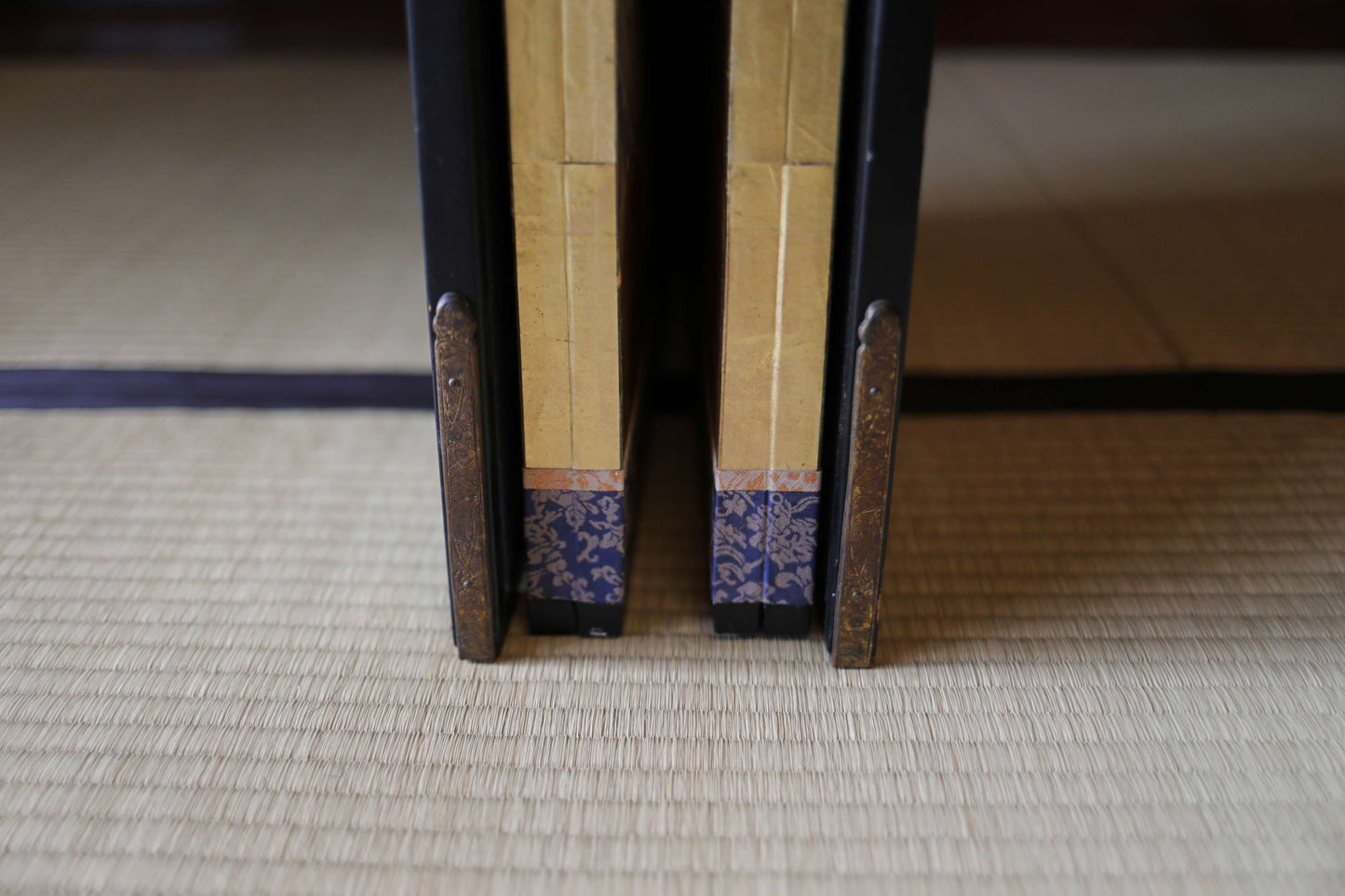
It was made in the late Edo period, but the cloth on the front and back edges was replaced during the Taisho period, so it is in good condition and can be displayed and enjoyed immediately.
In Japan, this furniture is called a “屏風 byōbu” (folding screen). It is a type of furniture used for room dividers and decoration. It consists of a wooden frame with several sheets of paper or other materials attached, designed to fold.
The history of folding screens, said to have originated in China, is long. They were already used as windbreaks during the Han Dynasty (206 BC–220 AD). In Japan, during the Muromachi period (1336–1573), many ink wash paintings and highly colorful folding screens were produced.
Folding screens are convenient because they instantly transform a space's atmosphere simply by being placed, and they can be folded for storage.
□ Size: H 53.9in × W 111in × D 0.7in (about H137cm×W282cm×D1.7cm )
□ Weight :16lbs (7.3kg)
□ Material : wood, paper, Gold leaf, silk, metal,
condition...
In very good condition, but there is some dirt and scuffing due to age. Ready for immediate use.
Shipping
Shipping
Though we ship items free to most addresses in USA and Europe, we may ask to pay additional fee for shipping to remote addresses where DHL/FedEx apply. Any orders can be cancelled in this case.
Combined shipping is available for purchase two and more items.Please contact in detail before ordering to avoid several payment transactions.
Due to increase of shipping fee to Australia and New Zealand, free shipping is not applied for orders to be shipped there from 1st, September 2024. We will inform customers of additional fee after receiving orders. Items will not be shipped until customers reply and in case there is no agreement with the tariff, orders will be cancelled.
SKU:24516
View full details